
CHALLENGE 1
Challenge Description
Challenge #1: Strong @ Sea – Innovating Resilience and Safety in Ships
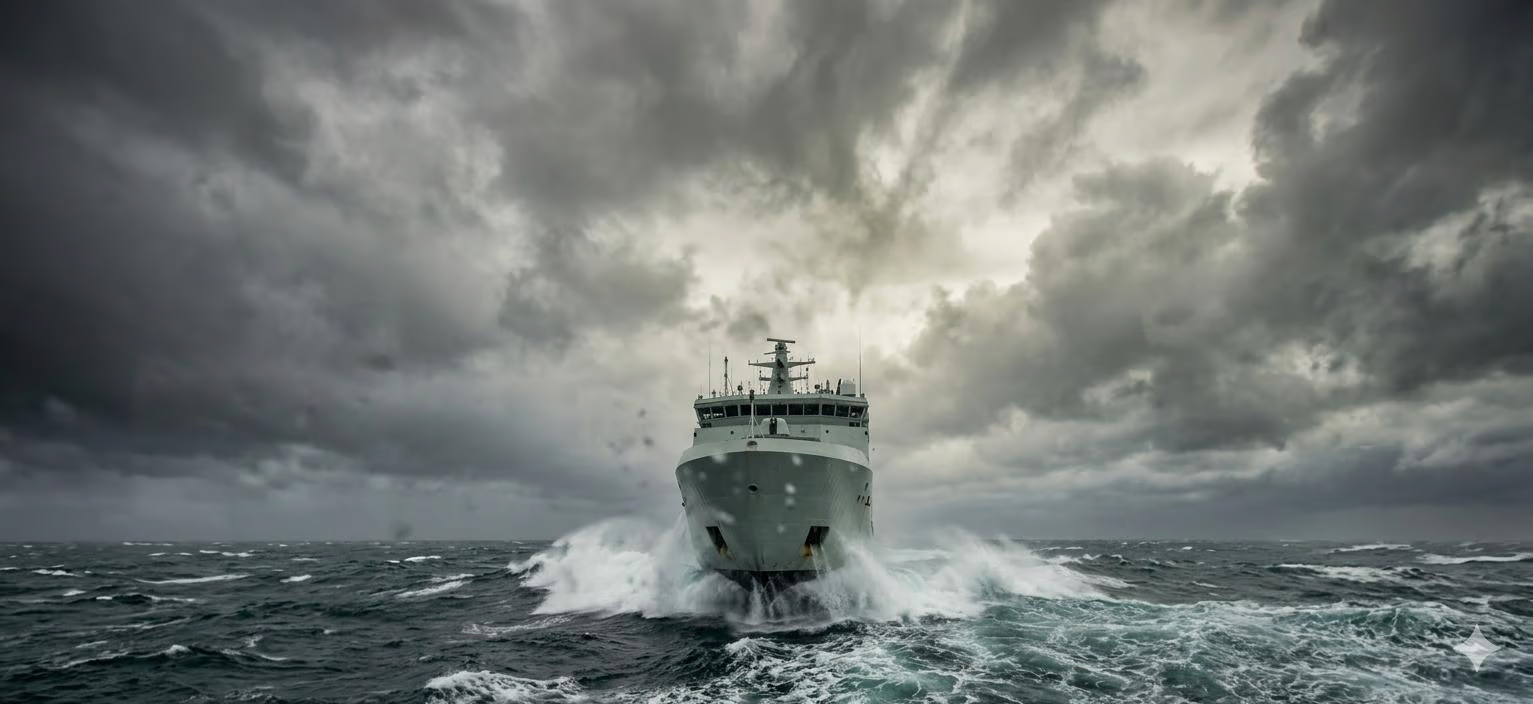
To remain operationally effective, Canadian Naval and Coast Guard ships must be equipped to endure severe environmental conditions, encounter confront risks and remain forceful against adversaries, while managing operational challenges and protecting their crews. Enhancing the resilience, self-sufficiency, and safety of these vessels are enduring priorities for Canada’s defence community and Royal Canadian Navy. This challenge seeks practical, innovative, and demonstrable solutions that leverage modern technology to strengthen Canadian ships resilience and recovery from the strenuous impacts of maritime operations.
What we are looking for:
We are seeking solutions that can be developed and demonstrated in a naval or maritime security context. Proposals should aim to create a functional prototype addressing one or more of the following areas:
- De-risking Inspection and Survey: Systems designed to perform hazardous tasks currently undertaken by sailors. This could include solutions for inspecting hazardous spaces without human entry, or advanced non-destructive testing methods and hardware for surveying hull fatigue and structural integrity without first removing the crew.
- Novel Non-Intrusive Equipment Monitoring: Technologies that use unconventional data sources to assess equipment health without invasive inspection. This could include acoustic hardware that captures machinery sound signatures to detect subtle, sub-audible faults, or hardware solutions to accelerate the extraction of health data from stand-alone systems.
- Next-Generation Crew Safety and Monitoring: Technologies that automate the monitoring of personnel in hazardous environments. Solutions that can monitor and alert using intelligent vision systems to act as a “virtual sentry” that detects accidents or dangers, or provide reliable, through-deck communication systems that can locate and page individual crew members without ship-wide broadcasts.
- Enhanced Platform Self-Sufficiency and Resilience: Technologies that make the vessel less reliant on external support or more resistant to operational hazards. This is a broad category that could include the application of advanced materials, such as lightweight, fire-retardant composites or self-healing anti-corrosion coatings that passively increase the ship’s survivability, or solutions to allow operators to ‘hold-fast’ longer at their stations in smoke-filled scenarios before evacuation
Additional Considerations:
- Propose technologies at Technology Readiness Level (TRL) 6 or higher
- Shows strong potential for the solution to become viable and sustainable
- Address regulatory challenges, including shipping code compliance, within the proposal
- Demonstrate awareness of government security and clearance requirements, including timelines for exchanging engineering data, if applicable
Thales’ Goals
This initiative aligns with Thales’ ambition to:
- Lead Innovation in AJISS: Strengthen the Arctic and Offshore Patrol Ships (AOPS) and Joint Support Ships (JSS), also known as AJISS, programs through advanced technology integration
- Leverage SME Agility: Tap into the unique speed, creativity, and ecosystem advantages of start-ups and SMEs, especially in Atlantic Canada
- Accelerate the AJISS Roadmap: Position successful solutions for integration through a Value Engineering Change Proposal submitted to AJISS stakeholders
Deadline: July 24, 2026
Award: $187,500
Rules & Requirements
Eligible applicants may submit one proposal per challenge in either English or French.
Each application must include the following components:
- Solution Description and Impact: Clearly describe your proposed solution, its practical applications, and the expected benefits
- Novelty of the Innovation: Explain how your solution is unique or significantly advances the state of the art
- Organizational Capability and Resources: Highlight your team’s expertise, infrastructure, and access to necessary resources
- Relevant Technological Experience: Showcase your experience with technologies or methodologies relevant to your proposed solution
- Level of Innovation: Assess the ambition, originality, and transformative potential of your innovation
- Technology Development Roadmap: Present the current development stage and outline a clear plan toward full commercialization, including key milestones
Eligibility
The Naval Technology Innovation Challenge is Pan-Atlantic in scope and open to commercial and non-commercial organizations.
The challenge is open to:
- Incorporated businesses in Atlantic Canada
- Small and medium-sized enterprises, as well as Indigenous organizations
- Post-secondary institutions and other organizations can apply only if they partner with small or medium-sized businesses or Indigenous organizations
Evaluation Process
A selection panel will review applications using a weighted scoring system across the following categories:
- Solution fit: 25%
- Impact: 20%
- Expertise: 15%
- Resources: 25%
- Innovation: 5%
- Timeline: 10%
The panel includes representatives from COVE, Thales, the National Research Council, and an industry partner. After the application period closes, each panel member will independently evaluate submissions using a standardized scoring package.
Once scoring is complete, the panel will convene to review the results and select the winning company. Before making any public announcement, the panel will notify the selected applicant. COVE will then coordinate with the winner to manage communications.
Note: The selected company must submit financial statements before the final announcement.